HIPAA compliance in 2026 isn't the same beast it was five years ago. If you’re running a medical or dental practice in Ventura or Santa Barbara, you already know the pressure is mounting. The Department of Health and Human Services (HHS) isn't just looking for a "good faith effort" anymore. They’re looking for evidence of a living, breathing security framework.
For practices with 10 to 150 employees, the challenge is real. You’re navigating thin margins, a competitive hiring market, and a threat landscape that targets healthcare providers specifically because of the high value of patient data. Sitting still isn't an option. In fact, relying on outdated IT protocols is the fastest way to land on the OCR "Wall of Shame."
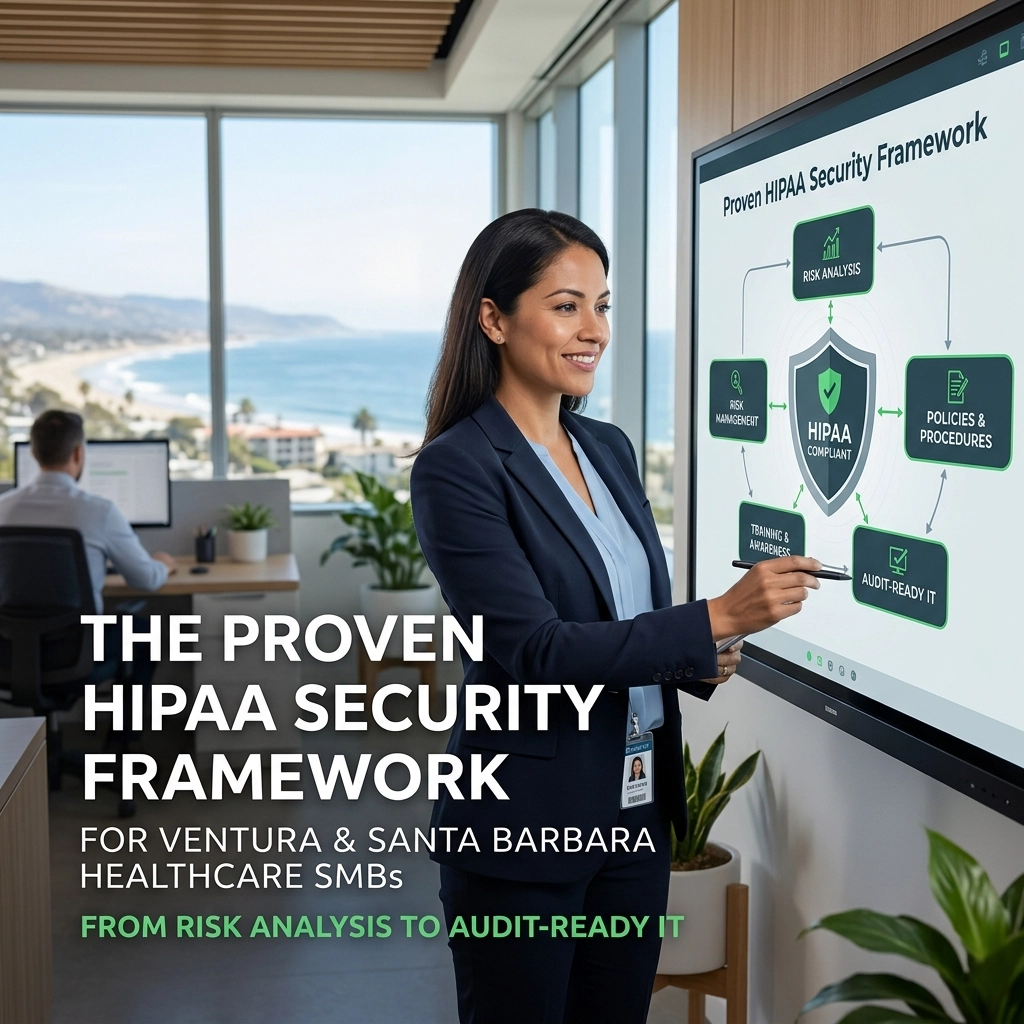
At Ideal Security and Technology, we’ve seen it all. With over 100 years of combined experience among our senior-level experts, we’ve developed a proven framework designed specifically for the unique needs of Central Coast healthcare SMBs. This isn't just about passing an audit; it's about building a resilient practice that can withstand modern cyber threats.
The Foundation: Why a "Check-the-Box" Strategy Fails
Too many practices treat HIPAA like a yearly DMV registration. You fill out a form, pay a fee, and forget about it for twelve months. But the reality of HIPAA compliance is that it’s a continuous cycle.
The data is clear: over 700 healthcare data breaches occurred last year alone, and the average cost per record continues to climb. For a small practice in Ventura, a single breach isn't just a legal headache: it’s a potential business-ender. When you factor in the 2025 HIPAA Security Rule updates, the bar for "reasonable" security has shifted significantly toward more technical, automated controls.
If your current it services ventura provider is just fixing broken printers and resetting passwords, you’re likely missing the core components of the Security Rule.
Step 1: The Comprehensive Risk Analysis
Everything starts here. You can't protect what you haven't identified. A proper Risk Analysis (RA) is more than a survey you hand to your office manager. It is a deep dive into every corner of your practice where electronic Protected Health Information (ePHI) might live.
We’re talking about:
- Your EHR/EMR systems.
- Imaging machines and local servers.
- Patient portals and billing software.
- Email accounts and mobile devices used by staff.
- Cloud storage and third-party vendor access.
A common pitfall we see with managed it services ventura is failing to document the "likelihood and impact" of specific threats. It’s not enough to say you have a firewall. You need to document how that firewall mitigates the risk of unauthorized access and what happens if it fails.

Step 2: Implementing Modern Technical Safeguards
In 2026, "technical safeguards" have evolved. Basic antivirus is no longer enough to satisfy auditors or insurance carriers. To get audit-ready, your network security services ventura must include:
Mandatory Multi-Factor Authentication (MFA)
MFA is now table stakes. If a staff member can log into your patient records with just a username and password, you are non-compliant. Period. We implement MFA across every access point: remote, administrative, and local.
Encryption at Rest and in Transit
Encryption isn't optional anymore. Your data needs to be scrambled whether it’s sitting on a server in your Santa Barbara office or traveling through an email to a specialist. If a laptop is stolen and it isn't encrypted, that’s an automatic reportable breach. If it is encrypted, it’s often a "non-event."
Network Segmentation
This is where many generalist IT shops fall short. Your guest Wi-Fi, your office printers, and your EHR server should not be on the same "flat" network. We segment your network so that if a hacker compromises a receptionist’s workstation, they can’t hop over to your database of 10,000 patient records.
Step 3: Administrative Governance and the "Human Firewall"
Technology is only half the battle. The most sophisticated it support santa barbara cannot stop a staff member from clicking a malicious link if they haven't been trained.
Administrative safeguards involve:
- Sanction Policies: Do you have a written policy for what happens when an employee snoops on a neighbor’s medical record?
- Regular Training: One-off training during onboarding is useless. We help practices implement ongoing security awareness training that keeps compliance top-of-mind.
- Access Reviews: People change roles or leave the practice. If your former billing clerk still has active credentials three months after they left, you have a major compliance gap.

Step 4: Vulnerability Management and Penetration Testing
This is the "stress test" for your security. The latest standards for healthcare SMBs suggest vulnerability scans at least every six months. At Ideal Security and Technology, we go further. We don't just scan; we interpret.
A scan might show 50 "critical" vulnerabilities, but our senior experts know which ones actually put your ePHI at risk. We prioritize remediation based on the actual threat to your practice, not just a software score. This pragmatic approach saves you time and ensures your budget is spent on fixing the most dangerous holes first.
Step 5: Managing Third-Party (Business Associate) Risk
You are only as secure as your weakest vendor. Under HIPAA, your Business Associates (BAs): cloud providers, billing companies, even your shredding service: must have a signed agreement (BAA) in place.
But a signed paper isn't enough. You are expected to exercise due diligence. Are your vendors following the same high standards you are? We help our clients vet their vendors to ensure that a breach at a third party doesn't end up being your financial responsibility.
Why Local SMBs Need Senior-Level IT Expertise
Many medical practices in Ventura and Santa Barbara think they are too small to be a target. The hackers know this. They assume your IT is being handled by a "friend of the family" or a cut-rate provider that doesn't understand the nuances of HIPAA.
Working with Ideal Security and Technology means you get more than just a help desk. You get a team with a century of experience navigating the intersection of technology and regulation. We understand that your priority is patient care, not managing server logs.
Our framework is designed to get you "audit-ready" and keep you there, without the stress of wondering if your systems will hold up under scrutiny. Whether you're looking for it services ventura or specialized compliance support, we provide the senior-level oversight your practice deserves.
Moving Toward Audit Readiness
The path from a disorganized IT setup to a fully compliant, audit-ready framework doesn't happen overnight. It requires a strategic shift in how you view your office technology.
Stop looking at IT as a cost center and start seeing it as the armor that protects your practice's reputation. When an auditor asks for your risk management plan or your incident response protocols, you want to hand over a professional, documented system: not a stack of disorganized notes.
If you’re ready to stop guessing about your compliance status, it’s time to speak with experts who understand the local landscape. We’ve helped countless practices in Ventura and Santa Barbara County turn their IT from a liability into a strength.
Staying ahead means acting now. Don't wait for a "we’ve been hacked" notification to find out your framework was missing a foundational piece. Let’s get your practice secure, compliant, and ready for whatever the 2026 regulatory environment throws your way.